
Powering a publishing renaissance
A media tech company headquartered in New York, Quintype builds digital publishing technology for the modern newsroom. Their suite of products comprise a content management system, an audience engagement platform, a subscription management tool and a front-end page builder, all working together as an integrated stack that any publisher can deploy and run without a dedicated tech team. By 2019, the products were mature, customers were on board, and the business was ready for its next stage of growth. Lmntree’s scope of work included positioning for the brand and the products, website content, a sales deck and a content strategy.
The Context
Between 2015 and 2019, the shift from traditional to digital publishing accelerated with established players going digital-first and new publishers emerging fast. And the trends in subscription models, audience engagement, social distribution, user-generated content were evolving and transforming rapidly. Publishers at every level were expected to keep pace.
It wasn’t easy, because technology wasn’t helping them. For larger publishers, the issue was legacy systems built for an earlier era of publishing that were slow to change, expensive to maintain, and poorly suited to a world where the relationship between a publisher and its audience had fundamentally shifted. For smaller publishers, often running lean teams with people covering multiple roles, editorial desks were involved in the tech side of things. Figuring out the technology was becoming its own job for editorial staff.
The platforms that handled digital publishing well (fast, integrated, built for newsroom realities) were largely available only to big media houses. Arc, Adobe, proprietary builds by the Washingtons Posts and the Vox Medias of the world. Everyone else was improvising.
Quintype changed this status quo. The same capability that had been the preserve of large publishers, was now available to publishers of any size, on plans that scaled with them. The products were proven. Publishers who had made the switch swore by what the benefits were. What the business needed was a way to communicate all of that to the market with clarity.
The Discovery
We started with full demos of the entire suite, followed by conversations with both the Quintype team and their customers.
- Demos to understand what each product was solving in a working newsroom context, Deep-dive into the features and what they enabled
- Conversations with people across the technology, operations, sales and account management teams
- Customer surveys to map digital publishers’ challenges and their relationship with technology – the good and bad of the tools they had been working with before, how involved they were in tech decisions, what it meant to not have to deal with tech every day
Two things stood out.
The team had an unusually consistent understanding of what they were building and why. Across the organisation, there was a shared sense of purpose and a genuine pride in what the technology did for publishers. That alignment showed up in the products themselves. The suite worked together in a way that felt considered at every level.
During our conversations we found that publishers who had spent years navigating slow systems, going back to the drawing board every time the industry moved, dealing with technology that created its own set of problems, had found something that let them get back to their craft knowing that’s all they needed to focus on. The advocacy was specific and unprompted. The kind of response that comes from a product that’s more than satisfactory, and lives in the delight territory.
Both sets of conversations led to the same thing: this was a company that understood what publishers actually needed, and were committed to not only building but also delivering exactly that in a way that was easy for the audience to adopt.
The Positioning
All the research pointed to Quintype’s role as a liberator of content from the shackles of technology and its constant demands. Good technology works invisibly, not asking to be noticed, not slowing things down, not requiring its own team to keep it running. What Quintype gave publishers was the freedom to focus entirely on their content and their audience, and the tools to build the kind of engaged, subscribing, returning readership that modern digital publishing demands.
The brand voice followed: enthusiastic and grounded. An ardent supporter of publishers, not a vendor pitching at them. We landed on a calm, mature, observant revolutionary. Someone who questions why things are the way they are and helps bring in a new way, without making a performance of it.
The positioning: The power of content, liberated.
This translated into a communication idea that gave the website, the sales deck and the content direction a consistent character and point of view.
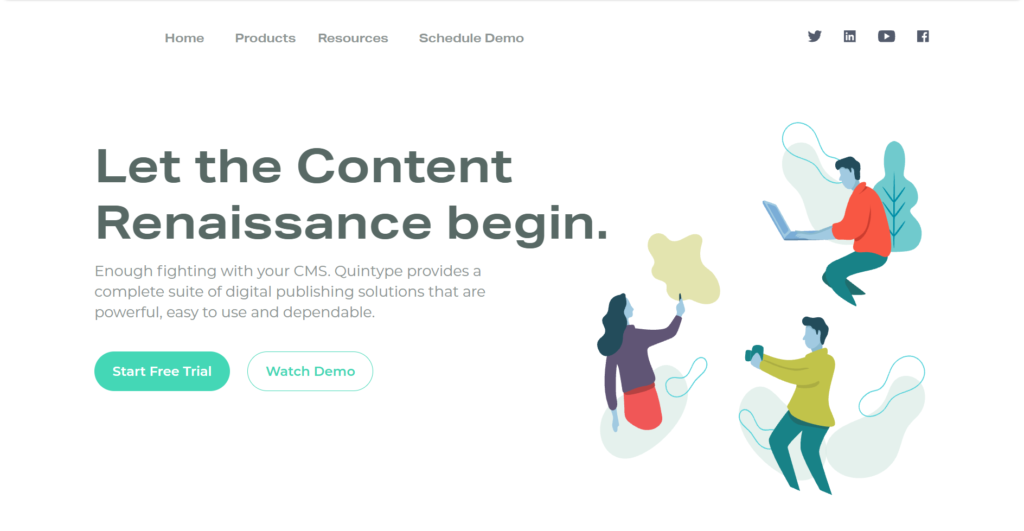
Let the content renaissance begin.
On the website, each product was introduced with a line that captured what it gave back to publishers:
- Bold (CMS)
All the content liberation tools you have wished for. And, all those you haven’t yet.
- Metype (Audience engagement)
Get people talking.
- Accesstype (Subscriptions)
Turn readers into faithful followers.
- Ahead (Page builder)
Powerful presentation for your powerful content.
In Execution
The website brought the brand’s role and tone alive across every page. The writing spoke to publishers from a place of genuine understanding of their world. The question on the homepage set the register: How can you start a renaissance if you are too caught up figuring tech?
The sales deck took the same thinking into direct conversations with potential clients — opening with the question the business existed to answer, establishing the philosophy, then presenting the suite as the practical expression of it.
The content strategy gave the blog a clear editorial identity, point of view and brought alive the liberator role from the positioning. Questioning what the industry had come to accept as normal. Why do editorial decisions still wait on tech timelines? What does it mean to truly own your reader relationship? Why do big ideas have to wait for big support? Fact-led, direct, featuring exactly what publishers were actually dealing with.
Five Years On
The website ran with this content for over five years. In that time, Quintype grew from a handful of clients to over 300 publishers across the world, reaching over a billion readers a month. The positioning gave the brand a consistent language and identity to stand on during a rapid scaling phase with new products, new markets, and a publishing landscape that kept moving.
None of that is attributable to positioning alone. The product and the team behind it did an outstanding job of committing to their vision. But the brand gave all of it a coherent story, a clear sense of what Quintype stood for, and who it was for.
Sometimes what a business at an inflection point most needs is clarity about what it already is. That was the brief and that’s what we delivered.
Lmntree worked with Quintype in 2019 on brand positioning, website content, sales deck, and content strategy.