
It came as enlightenment. With the promise of a future of clarity and truth after decades of marketing in the dark. The underdog fighting the established big media of the day. A child of innovation and ingenuity, with a halo of awesomeness around. Standing on pillars of precise targeting, measurability, interactivity, cost-effectiveness and democratisation. A shift from faith and instinct to reason and evidence. Every click, every sale, every drop-off visible, explained, actionable. You get the drift.
It proliferated as dogma, backed by scientific-sounding jargon. Presented as absolutely factual and so inevitable that anyone who questioned it was instantly labelled a relic — a madman, bitter about being left behind, crying sour grapes into his old-man-scotch.
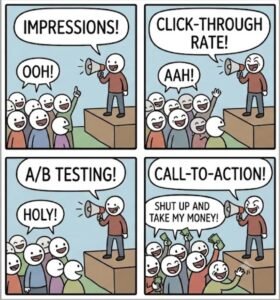
The jargon played a starring role in spreading the dogma with fervour. Impressions. Ooh! Click-through rate. Aah! A/B testing. Holy! Call-to-action. Shut up and take my money!
And they did.
Most of these weren’t new concepts, but familiar ideas dressed up in pretentious vocabulary and an air of superiority so innate that nobody dared question whether they made sense.
Take for example, ‘Customer Acquisition’. A customer acquires a product or avails a service. In the world of digital marketing, it’s the business that acquires the customer. Forget ‘customer is king’; the customer is not even a pawn here, just something to be profiled and acquired and engaged with and retained and a/b tested.
Or ‘Call-To-Action’, sounding important like the start of a small revolution, a march against injustice, an awakening from a decade of slumber, when all it does is tell people to ‘Buy Now’, ‘Know More’ or ‘Sign Up’. The fact is, when the value is clear and relevant, people don’t need to be reminded or pushed. In the real world if someone popped up from behind a rack and said “Buy Now!”, you’d think it creepy. But performance marketing has to literally be a performance put together by all these jargon actors.
Or ‘Engagement’. A deeply meaningful word that says you’re entering into an agreement or relationship of some kind. Except in digital marketing, where if you paused for a sip of your coffee mid-scroll and a video happened to autoplay, you’re engaged.
True story: We were auditing the ux of a job platform by calling up users who signed up and took a specific action like filling their profile, applying for a job or downloading an assignment. Some of them only vaguely remembered signing up even if they had just done it earlier that day. Most of them did not remember the brand name and had to be reminded about the action they had taken to make the connection. If the user didn’t form an impression of the brand after doing so much, what exactly are these vanity metrics tracking?

The list goes on.
- Growth Marketing as opposed to what, decline marketing?
- Performance as opposed to rehearsal?
- Data-driven as opposed to… Guess-driven?
- Personalisation. A joke that writes itself and starts with “Hello, {Firstname}”.
- Funnel. People are not oil, and nor does purchase happen in neat steps when an Ideal Customer Profile goes through the Conversion Journey exactly as designed. Its counterpart, the Pipeline, is equally unrealistic and dehumanising. It’s almost as if someone is on a vendetta for how hard 3D geometry was for them in school.
- Lifetime Value, which turns future revenue into a metric today against which exorbitant CACs become justifiable. In all honesty, it’s a metric that favours ad platforms more than businesses, who are better off benchmarking CAC against AOV or even Annual Revenue per customer, keeping things grounded and real in the foreseeable future.
- Targeting: Once digital marketing’s greatest promise and differentiator, now reduced to stalking, often for months after the purchase has happened, often without advertising’s involvement.
Which brings us to Attribution. The credit-taking industry became so good at taking credit that it invented seven different ways of deciding who gets the credit among the industry’s star players. The existence of seven models tells us there is no single correct answer, which is ironic for an industry whose central theme is precision and correct answers only. Every model has a different assumption about how people made the purchase decision. None can tell you what actually caused them to buy. They can only tell you how you chose to divide the credit. Which isn’t that much more data-driven than non-digital marketing.
There’s more, and if we examined each in greater detail, a picture of such absurdity emerges that doing day-to-day work with these concepts gets difficult. But it’s not all bleak.
Despite all of its grandiosity and flaws and delusions, digital marketing does have genuine merits. The pillars of precise targeting, measurability, interactivity, cost-effectiveness and democratisation do exist, though to a less-than-ideal degree post-enshittification. And it has had an impact especially for startups and small businesses. That’s worth something.
But that doesn’t change the fact that the digital marketing industry convinced an entire generation of business leaders that marketing is platforms, dashboards and tools rather than products, pricing, positioning, distribution, customer experience and reputation. Marketing became all about buying marketing from marketing companies and the companies that mushroomed to make those marketing companies market themselves. Startups spent all their funding chasing growth on the back of paid campaigns, forever optimising and chasing this metric or that. And when the money ran out, realised they don’t have anything real to call their own. Whatever they thought they had — the lifetime value, the acquisitions — all belonged to the platforms.
Today, after doing an outstanding job of marketing itself, the digital marketing industry lives on. It thrives as noise that the customer can’t escape, and a crutch for the instinctless.